1066: The Only Date All Brits Know

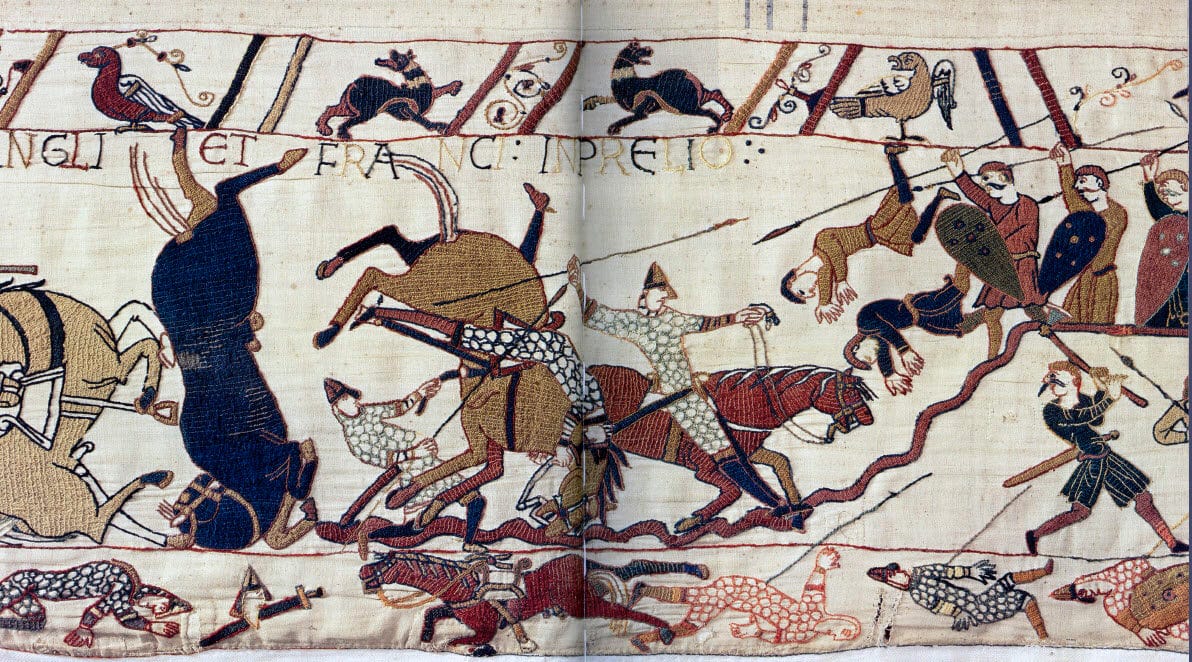
Think Game of Thrones. Instead of the Iron Throne, we have the throne of England up for grabs, three candidates, and a lot of bloodshed.
England just before the Norman conquest is just that—it doesn’t include Wales or Scotland yet, and was technically only conquered by Vikings a couple of generations ago and still suffering frequent coastal raids. It’s divided into earldoms which answer to the king. but the earls’ estates are further divided into Hundreds (a collection of one hundred households with a court to settle local matters), a name that still exists within some land descriptions. London is the center of trade, and King Edward (later sanctified and known as Edward the Confessor) has begun to build the Palace and Abbey of Westminster, a mile downriver, possibly planning to move the royal seat from the current capital, Winchester.
But Edward has no direct heirs. The correct procedure in this case should pretty much mirror that set out by the Academy of Motion Picture Arts and Sciences. We anticipate a not particularly star-studded event in which the leading nobles of England elect the new king from among their peers, just like the Academy Awards. Except this doesn’t happen. But as he's dying in 1065, shortly before his death, Edward wakes to tell of a dream where two monks appeared to tell him England is destined for war and chaos. How right he is.
Three warlords are determined to claim the throne and so this The Bachelor equivalent of 1066 presents our candidates:
- Edward’s brother-in-law and right-hand-man Harold Godwinson. who claims that the late king appointed him his heir, but apparently forgot to mention it to anyone else. Interests: brutal warfare.
- William the Conqueror, a.k.a William of Normandy, a.k.a. William the Bastard (which he was in all definitions of the word). He claims that in 1051 he visited his distant cousin King Edward, who named him the heir to England. Furthermore, he says Godwinson swore an oath that he would support William’s claim to the throne. You have to wonder why, but at that date Harold was not as tight with Edward as he later became. Interests: brutal warfare and eating.
- Harald III, King of Norway, whose grandfather was the last Viking to invade England, which gives him a claim of sorts, or at the very least a family tradition to follow. Named Hardrada, or hard leader, and yes, he too really enjoys brutal warfare.
After Edward’s death on January 4, things move very quickly. On January 6 the Abbey of Westminster hosts a double billing, a special episode of Dancing With the Stars where Harold Godwinson wows with his slick moves from tomb to crown--the royal funeral and a coronation on the same day.
Harold is now King of England and the richest man in Europe. But for how long?
Shortly afterward, Harold exiles his brother Tostig, Earl of Northumbria. Tostig approaches William of Normandy looking for a possible collaboration, and is apparently rebuffed. However, Harald Hardrada is very interested, and starts sharpening his Viking battle ax.
As the year progresses, a terrible omen appears in the sky, an appearance of what was later named Halley’s Comet. The Anglo-Saxon Chronicle, a collection of manuscripts from various religious houses around the country, records:
At that time throughout all England a portent such as men had never seen before was seen in the heavens. Some declared the star was a comet, which some called the “long haired star:” it first appeared on the eve of the festival of Letania major, that is on the 24 April, and it shone every night for a week.
In September, Harald Hardrada’s three hundred warships sweep down the east side of England, sail up the River Ouse, and take the city of York. Tostig meets him there with recruits from Scotland and Flanders, bringing the total invading army up to about 9,000. They are met by King Harold and his army of 12,500 at Stamford Bridge five miles east of York. On September 25, 1066, Harald and Tostig are killed along with 8,000 of their men, giving a decisive victory to King Harold.
Meanwhile William of Normandy has been preparing for invasion and war. He is able to do what both Napoleon in the nineteenth century and Hitler in the twentieth failed to do—ship arms, equipment (including warhorses in this case), and men across the English Channel, which, while only twenty-two miles at its narrowest point, is famously unpredictable. He lands at Pevensey, Sussex, days after Harold’s victory in the north. From William’s point of view, Harold has broken an oath made before God, and this serious sin gives him the moral authority to take the throne.
The Anglo-Saxon Chronicle gives a brief, eloquent description of what happened (translation below and if you listen carefully you will recognize many of the words).