In Celebration of the Jane Austen Bicentenary: 10 Reasons Why We Still Value Her Writing after 200 Years
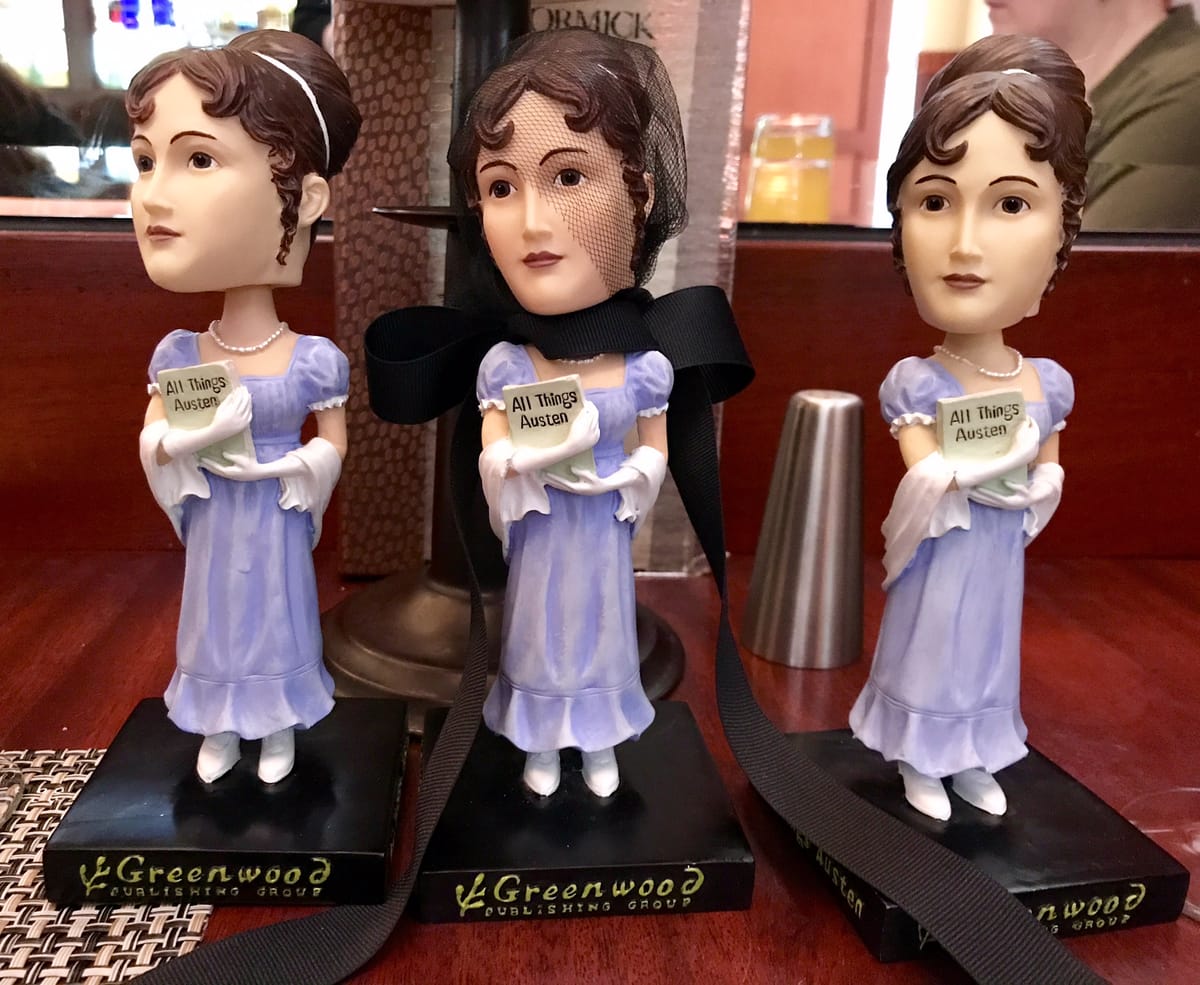
My friends and I met for brunch on Sunday to honor the bicentenary of our favorite author, Jane Austen. We brought our Austen bobblehead’s to the party, ordered Austentini’s, which unfortunately the bartender could not produce because they did not stock Limoncello (Scandalous!), and generally acted like the privileged heiresses that Austen loved to mock in her novels. (Caroline Bingley, anyone?) Our waiter was not amused.
Tuesday, July 18th marks 200 years since Miss Austen’s death in 1817 at the crushing age of 41. Scholars continue to debate if it was cancer, Addison’s disease, or arsenic poisoning that took her life. Regardless of the cause, she was cut down in her prime having only produced six novels, one novella and a sundry of minor works. While other early nineteenth century authors have fallen into obscurity, Austen’s works have remained in print, grew in popularity throughout the Victorian era and have been embraced by Hollywood in the twentieth century—elevating her to pop culture icon with the new millennium. Would Austen be taken aback by her stardom two hundred years after her death? Most assuredly.

There is no question that her small literary legacy packs a powerful punch. Emma, her fourth novel, has survived the weight of scholarly scrutiny to change the face of fiction and the popular acclaim of her hero Mr. Darcy from Pride and Prejudice continues to produce the “Darcy Effect”. Even her dark horse Mansfield Park recently received an elaborate annotated edition by the venerable Harvard University Press!
Each of her novels have been adapted for television multiple times for Masterpiece Classic who broadcast The Complete Jane Austen in 2008, including four new adaptations and repeating Emma (1996) staring Kate Beckinsale in the titular role and Pride and Prejudice (1995) staring Colin Firth as a Mr. Darcy who converted more to the Austen fandom than anyone before, or since. On the big screen, actress Emma Thompson shared the screenwriting credits with Austen when she adapted Sense and Sensibility, winning an Academy Award for their efforts, and her novella Lady Susan surfaced in 2016 as a new film by indie favorite Whit Stillman, entitled Love and Friendship. There are also numerous nonfiction books chronicling her life and times; sequels and spinoffs inspired by her plots and characters; as well as websites and blogs, and tie-in merchandise galore! All this from a parson’s daughter who never married, published her works anonymously as “A Lady” and died unexalted. Austen’s novels are like a long shot winning the Kentucky Derby. Good breeding and money doesn’t always produce the desired result, but talent will out.