What Did the Real Jane Austen Look Like?

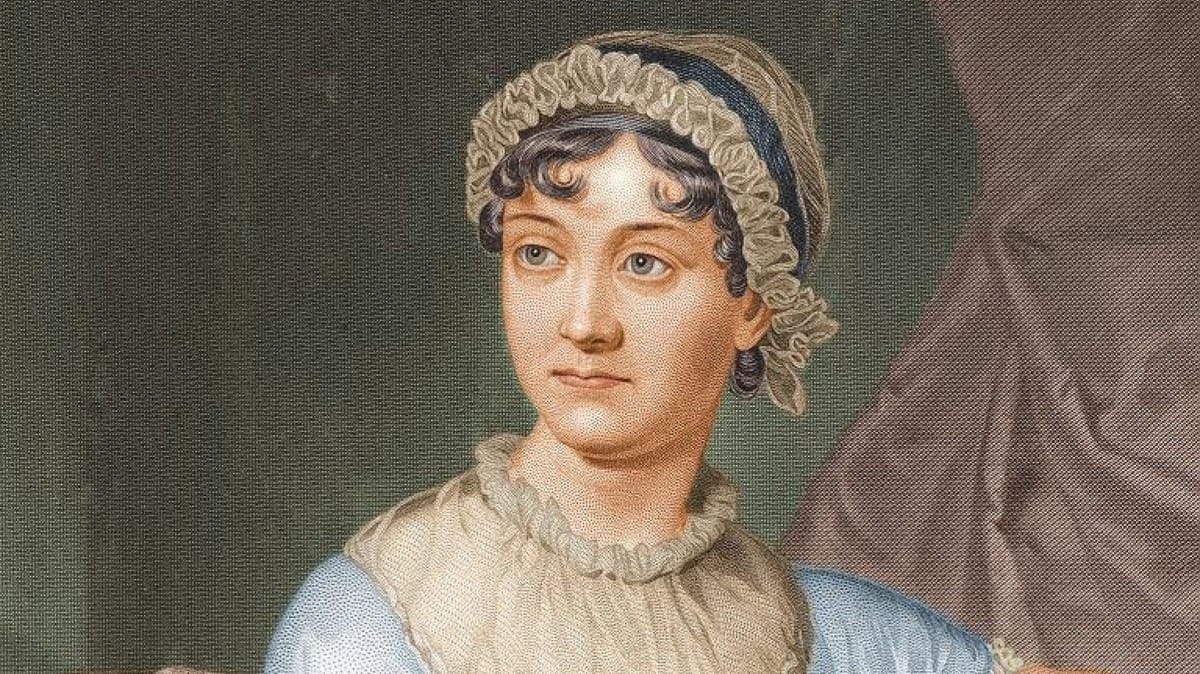
On the 18th inst. at Winchester, Miss Jane Austen, youngest daughter of the late Rev. George Austen, Rector of Steventon, in Hampshire, and the Authoress of Emma, Mansfield Park, Pride and Prejudice, and Sense and Sensibility. Her manners were most gentle; her affections ardent; her candor was not to be surpassed, and she lived and died as became a humble Christian. (Hampshire Chronicle and Courier, July 22, 1817)
She was the sun of my life, the gilder of every pleasure, the soother of every sorrow; I had not a thought concealed from her, and it is as if I had lost a part of myself.
That’s Cassandra Austen writing to her niece Fanny Knight on the death of her beloved sister Jane Austen, who died 202 years ago this month (July 18, 1817). She was only 41 and left behind six novels, some letters (she and her family were prolific letter writers but her sister destroyed many of Jane's after her death), a handful of manuscripts, a few belongings, and much speculation about her life.
Austen herself remains a mystery in many respects, and in particular we don’t really know what she looked like. She probably didn’t look much like Anne Hathaway or Olivia Wilde, but years later her nephew and niece described her:
Her figure was rather tall and slender, her step light and firm, and her whole appearance expressive of health and animation. In complexion she was a clear brunette with a rich colour; she had full round cheeks, with mouth and nose small and well-formed, bright hazel eyes, and brown hair forming natural curls close round her face.
… as to my Aunt's personal appearance, hers was the first face that I can remember thinking pretty … Her face was rather round than long – she had a bright, but not pink colour – a clear brown complexion and very good hazle [sic] eyes … Her hair, a darkish brown, curled naturally – it was in short curls around her face.
One of the most famous, and possibly most controversial picture of Jane, and certainly the most attractive, is the Rice Portrait, so called because it is owned by the Rice family, sixth-generation descendants of the Austens. It has been bickered over for decades, with the National Portrait Gallery in London refusing to give it the seal of authenticity, but keeping an open file as new evidence emerges, which it frequently does.
Thought for years to have been painted by Johann Zoffany, it is now attributed to Ozias Humphry and supposedly portrays Jane when she was about eleven. A 1910 photograph of the painting was subjected to high tech analysis a century later and the artist’s signature, the name of Jane Austen, and a partial date were revealed, but that evidence was destroyed by a fire in 1920.

The first published research on the painting claimed that it could not be authentic because the dress depicted in it dated it to around 1805, but costume experts have since pointed out that this style of children’s dress is correct for the 1780s (at this time girls’ fashions were often the inspiration for later adult styles).
You can read all about it at the portrait’s website, which has the latest findings—the discovery last month of a nineteenth century watercolor copy of the painting before the fire, and a document affirming the portrait’s provenance written (but not signed) by Jane’s niece Fanny Caroline Lefroy, from earlier this year. My fingers are crossed that this charming and lively portrait is authentic, and that it will remain in the U.K. so more people can see it.
The story of the painting is massively confusing. There’s a a summary of the case for authenticity here.

And now onto the wishful thinking and guesswork category. Traditionally, it’s thought that this sketch above of Mary Queen of Scots in the manuscript of The History of England, 1791, is actually based on Jane. The work was a joint effort between Jane, writing with brash humor and energy, and her elder sister Cassandra Austen as illustrator. Jane was 15 at the time. You can view the whole manuscript online at the British Library.

This silhouette of Jane Austen is used everywhere yet it may not actually be her. L’aimable Jane is written on the paper, which was discovered between the pages of a second edition of Mansfield Park and is dated to sometime betwen 1800-1815.
Although I love this silhouette I can't help but think that this discovery sounds like, well, something out of a book.

Another silhouette was given to Winchester Cathedral (where Austen is buried) in 1956 by yet another Austen descendant, Jessie Lefroy--“Jane Austin [sic] done by herself in 1815,” according to the inscription on the back. Stylistically, however, it appears to be late nineteenth century.
Here’s another portrait that I hope is actually of Jane Austen, a watercolor portrait by Rev. James Stanier Clarke, Domestic Chaplain and Librarian to the Prince of Wales, later George IV.

Austen was invited to the library since Prinny was a fan (she reluctantly dedicated Emma to him), which she did in 1815 when she was staying with her brother Henry in London. The Rev. Clarke was something of a fanboy himself and kept an album of sketches, poems, and autographs of celebrity actors and writers. There are two unidentified portraits of women in his Friendship Album and this is one of them.
I love the confidence and fashionable panache of the subject. The painting has been subjected to various scientific tests as described in this article and is tentatively accepted as genuine, but failed to sell when it was last put up for auction.
The Rev. Clarke and Jane corresponded for a while, and she must have been amused by his mansplaining of literature and his suggestions for future novels. He advised her to write in the style of Walter Scott, and also suggested the character of an urbane clergyman, a lover of literature who is equally at home in London or in the countryside... hmm, I wonder who this character should be based on? Thankfully, Jane declined politely.
In 2011, Jane Austen scholar Paula Byrne acquired this graphite on vellum portrait, described in the auction catalogue as “an imaginary portrait of Jane Austen.” The name Miss Jane Austin is written on the back and the clothes date it to 1815. It shows a sophisticated, confident writer in her prime, far removed from the retiring spinster of Chawton (which Jane never was), seated at a window that looks onto Westminster, London.

It's caused quite a lot of excitement, particularly with the facial analysis linking the features to those of other members of the Austen family.
ere’s a clip from the 2011 BBC documentary Jane Austen: The Unseen Portrait?